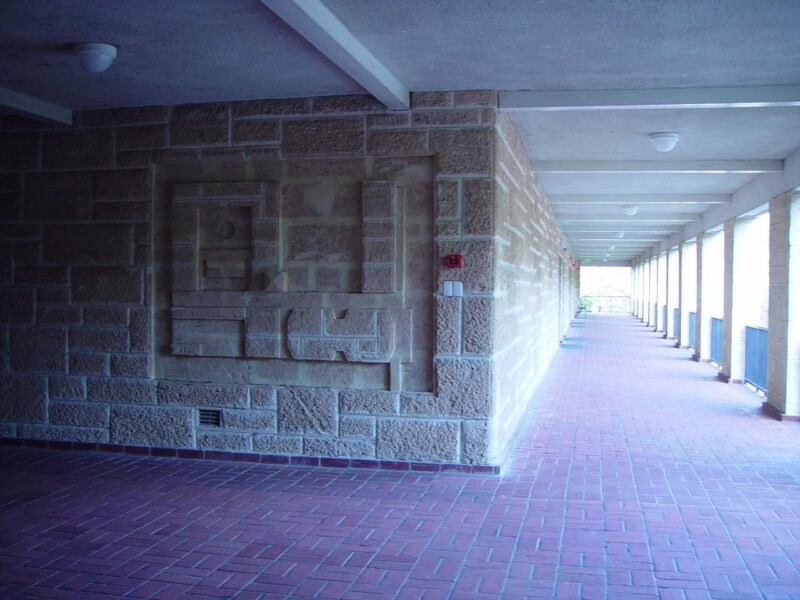
Standing three feet from a well-installed wall, most people cannot reliably tell quarried stone from the manufactured product. Standing three feet from the same wall twenty years later, almost anyone can. That gap is the honest way to frame this choice: the two materials start close and diverge slowly, and how much that matters depends on how long you intend to own the result.
One is quarried, the other is cast concrete
Natural veneer is real stone, cut or split to a thickness that lets it be applied as a facing rather than laid as a structural wall. Manufactured veneer is lightweight concrete, cast in moulds taken from real stone and coloured with pigment through the mix and on the surface. It is a genuine masonry product rather than an imitation panel, and the good ones are convincing. The difference that matters is not authenticity, it is that the colour in a manufactured unit is a finite layer while in stone it goes all the way through.
Weight is what drives the installed cost
Manufactured veneer weighs roughly a third to a half of what natural stone does per square foot, and that single fact cascades through the budget. Lighter units are faster to place, cause less fatigue over a day, need less structural support, and often avoid the need for a supporting ledge or shelf angle that heavy stone would require. Uniform thickness helps too, because there is far less fitting and cutting. The material price gap is real but the installation gap is usually larger, and on a big elevation the labor difference can exceed the material difference. Weight also decides what is possible on a retrofit. Adding heavy stone to an existing wall may require structural support that was never built into it, and once a shelf angle and its fixings enter the scope the cost comparison stops being about the facing at all.
How each one ages through freeze-thaw
Stone weathers rather than fails. It darkens, it grows lichen, mortar joints need attention every few decades, and most people consider the result an improvement. Manufactured veneer holds its appearance well for a long time and then reaches the end of a finite service life: the pigmented surface gradually fades, and in a climate with hard freeze-thaw cycling the exposed faces can begin to lose their skin. Once that starts on one elevation it is difficult to patch invisibly, because new units will not match aged ones.
The failure that ends a veneer job early
Whichever material goes on the wall, the majority of failures are water rather than product. Veneer of either type is a cladding, not a waterproof layer, and it depends on the assembly behind it: a weather-resistive barrier, a drainage plane, correctly lapped flashing, and weeps at the base that are actually open. When water gets behind veneer and cannot leave, it freezes and pushes units off the wall, and it rots whatever framing is behind. Installations that fail in under ten years almost always failed at the flashing, and no upgrade in stone quality compensates for it.
Matching an older house
On a period property the deciding factor is usually context rather than cost. Manufactured units repeat, because they come from a limited number of moulds, and on a large uninterrupted elevation the repetition becomes visible once you notice it. Mixing sources and orienting units deliberately reduces the effect. Natural stone has no such constraint, and where the house already has stone details, matching them convincingly is much easier with the real material. For a chimney breast, a garden wall, or a feature panel, the quantities are small enough that the price difference is modest.
Frequently asked questions
How long does manufactured veneer last? Reasonably installed, several decades, with the surface appearance gradually softening well before anything structural happens. Its life is shortest at ground level, in splash zones, and anywhere it is regularly wetted and frozen.
Can veneer be applied over existing brick? Often yes, provided the brick is sound and the assembly still manages water correctly. The wall has to carry the extra weight, and flashing and weeps have to be reworked rather than buried behind the new facing.
Does either need sealing? Usually not, and sealing can trap moisture. Where a manufactured product recommends a breathable treatment for a splash zone, follow the manufacturer instruction rather than applying a general-purpose film-forming sealer over the whole elevation.