Up in the Oro Valley foothills I once spent the better part of a day trying to dig a footing and getting maybe eight inches down before I hit caliche so hard it bounced the bucket. If you’ve built anything in the Tucson area you know the feeling. The homeowner wanted a retaining wall to hold back a slope that had already dumped mud across her driveway during monsoon season. Simple job on paper. In the desert, nothing about a retaining wall is simple, and I’ve been building them for more than thirty years.
What retaining walls cost in Tucson
For 2026, plan on $35 to $75 per square foot of wall face for a properly built retaining wall in the Tucson area, installed. A short garden wall might run $3,000 to $8,000; a tall engineered wall holding a real slope can run $10,000 to $30,000 or more. The spread is huge because a retaining wall isn’t a fence, it’s a structure fighting tons of soil and water, and the cost lives in the parts you can’t see: the footing, the drainage, and getting through the caliche. These are estimates, not guarantees.
Caliche: the reason your quote is higher than you expected
Caliche is a natural, cement-like hardpan layer in our desert soil, and it’s the single biggest wildcard in Tucson excavation. On some lots you dig through a few inches; on others you’re renting a jackhammer or bringing in heavy equipment just to trench a footing. I’ve had two jobs on the same street where one footing dug in an afternoon and the other took two days. Any honest bid for desert work accounts for caliche, and any contractor who quotes a slope wall without asking about your soil is guessing.
Caliche cuts both ways, though. It’s miserable to dig, but it’s also a firm bearing layer once you’re through it, which is part of why block and poured walls do well out here.
Block or poured, and building for heat and monsoon
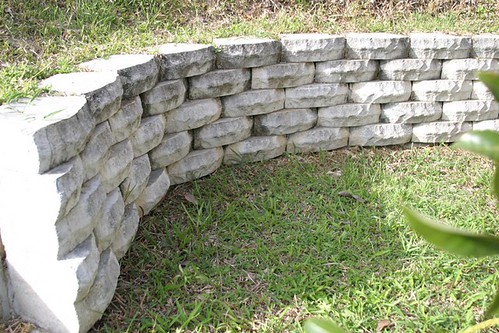
Most Tucson retaining walls I build are either segmental concrete block (SRW) or poured, reinforced concrete faced with block or stucco. Both work; they suit different sites and budgets. I compare them in segmental block versus poured concrete retaining walls, but for most residential slopes around Oro Valley, engineered segmental block with proper reinforcement is the workhorse.
The desert throws two things at a wall. First, heat and UV: relentless sun bakes and fades materials, and cheap sealers or the wrong block won’t last. Second, and more dangerous, monsoon flooding. From July through September we get sudden downpours, and the water finds every slope. A retaining wall without drainage behind it becomes a dam; the soil saturates, the pressure spikes, and the wall bulges or blows out. Proper gravel backfill, drainage stone, and weep holes or a drain pipe are not optional here, they’re the whole ballgame. If you want a Tucson masonry contractor to build something that survives a decade of monsoons, that drainage detail is the first thing to ask about.
Permits and when you need an engineer
In the Tucson area, a low garden wall usually doesn’t need a permit, but retaining walls above a certain height, commonly around four feet measured from the bottom of the footing, or any wall carrying a surcharge like a driveway above it, typically require a permit and an engineer’s design. You can confirm current thresholds with the City of Tucson or your local jurisdiction, since Oro Valley and Pima County set their own rules. Don’t skip this. An under-built tall wall is a genuine hazard, not just a code problem.
Frequently asked questions
Why is retaining-wall excavation so expensive in Tucson? Caliche, a rock-hard natural hardpan in our desert soil, often has to be broken with jackhammers or heavy equipment to dig a proper footing, and that added labor and machine time can put thousands onto a job.
How tall can a retaining wall be before I need a permit and an engineer? It’s commonly around four feet, measured from the bottom of the footing, but any wall holding an extra load like a driveway above it can trigger engineering at a lower height, so check with your local jurisdiction.
What kills retaining walls in the desert? Water, not heat: monsoon rain saturates the soil behind a wall that has no drainage, and the hydrostatic pressure pushes it out, so proper gravel backfill and weep holes or a drain are what keep a desert wall standing.